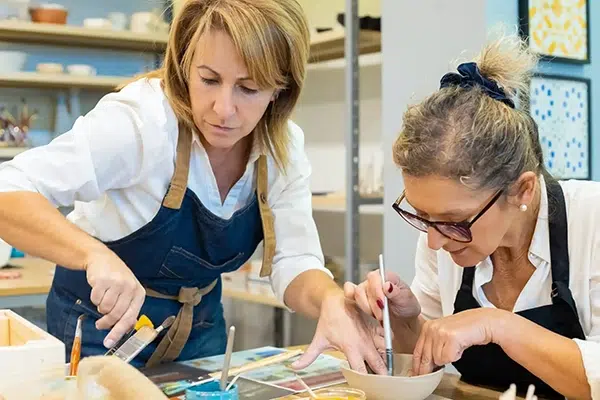
On a bright August day in Biddeford, Maine, the University of New England (UNE) Campus Center was abuzz with vibrant conversations as students shared expressive drawings with one another. These students were all participants in a Campus Colors & Connection workshop for first-generation college students hosted by The Foundation for Art & Healing and our wonderful partners at UNE. I was thrilled to visit this leading-edge institution in person to see our workshop curriculum in action.
Why Campus Colors & Connection?
Since 2021, Campus Colors & Connection has been a fixture of the UNE student experience. What initially drew UNE Vice President of Student Affairs and Dean of Students Jen DeBurro, EdD to Campus Colors & Connection was its simple, engaging format. She was excited to find an accessible curriculum with positive prompts that combined mindfulness, expressive coloring, and conversation to help students connect in authentic ways. Notably, the program aligned with UNE leaders’ commitment to addressing social disconnection and its negative impact on student wellbeing—a priority that had grown in urgency since the pandemic.
For young adults at UNE and across the country, COVID was a fragmenting force, disrupting their social development. “A lot of our students had very virtual experiences at parts of their middle school and high school careers,” said Shane Long, PhD, UNE’s Assistant Dean of Students. “I think that having fewer opportunities to interact with their peers in unstructured settings created a little bit of a skill gap.”
UNE leaders knew this skill gap wasn’t something to take lightly. Rather, it posed a threat to student wellbeing, retention, and success. They knew that without a strong social foundation, students would be at greater risk for loneliness and isolation, which could exacerbate mental health challenges like depression, anxiety, and suicidality, damage their immune systems, and make even routine interpersonal interactions feel threatening.
Campus Colors & Connection emerged as an easy, effective way to foster social and emotional wellness on campus. In 2024, UNE incorporated Campus Colors & Connection into Fall orientation for all 600+ incoming students. This year, the tradition continued with one modification: first-generation students had a dedicated workshop, helping them de-stress and connect from Day One.
Supporting First-Generation Students
For our partners at UNE, implementing a dedicated workshop for first-generation students felt like a necessary and natural next step in our collaboration. Dr. DeBurro said, “We’ve been holding steady at about 30% first-generation students for the past 5+ years, so supporting this population is a top priority. When I heard about The Foundation for Art & Healing’s initiative for first-generation college students, I knew it would be a wonderful opportunity to build on our work together.”
Dr. Long was especially excited to help deliver this program given his personal background as a first-generation student. He shared, “First gen students face all of the challenges that new students face, but also the feeling that they are different and maybe less prepared. They may feel some form of imposter syndrome or question whether or not they can be successful in this environment.” Serving as a Campus Colors & Connection facilitator allowed him to play a direct role in welcoming these students to campus and helping them connect with themselves and each other.
In his view, the workshop was a breath of fresh air during a busy start to the school year. By using color as a conversation-starter, the workshop created accessible pathways for students to reflect on their emotions and share them with others. He noted, “Art was a great way to engage these students in a quiet time in the middle of a really busy day of orientation programming, enabling them to pause, reflect, and connect with peers.”
Reflections from a Student
First-year UNE student Libby Whidden, who identifies as a first-generation college student, had a similarly positive response to the workshop. She shared, “It was really relaxing to be able to sit down and just color for a little bit and have a moment with my own thoughts. When I started drawing, I didn’t have a set plan, I was just going with what I was feeling in the moment. As I started coloring and adding details to my picture, it kept flowing, and it brought out things I hadn’t thought about before—things I’m excited about, maybe worried about for school. It was nice to just be able to put it all on the paper.”
In addition to creating space for reflection and relaxation, the workshop helped participants bond in meaningful ways. Libby noted, “I didn’t know anybody there. But after coming from that place of vulnerability the same way that everybody else at my table was, we were able to connect, and then it felt less lonely because I realized we were all in this together.” She kept in touch with two peers from her Campus Colors & Connection table and considers them friends.
What’s Next for UNE
These are challenging times for leaders in higher education as they navigate a cascade of changes at the federal level. “The unpredictability can be tough,” Dr. Long said. Even so, Libby’s reflections illustrate the kinds of experiences Dr. Long, Dr. DeBurro, and their colleagues hope to continue creating for UNE students at scale. Moving forward, they are interested in the ways arts-based workshops could help support students who may be especially prone to loneliness or disconnection, particularly in these uncertain times. We look forward to supporting their efforts in the months and years ahead!